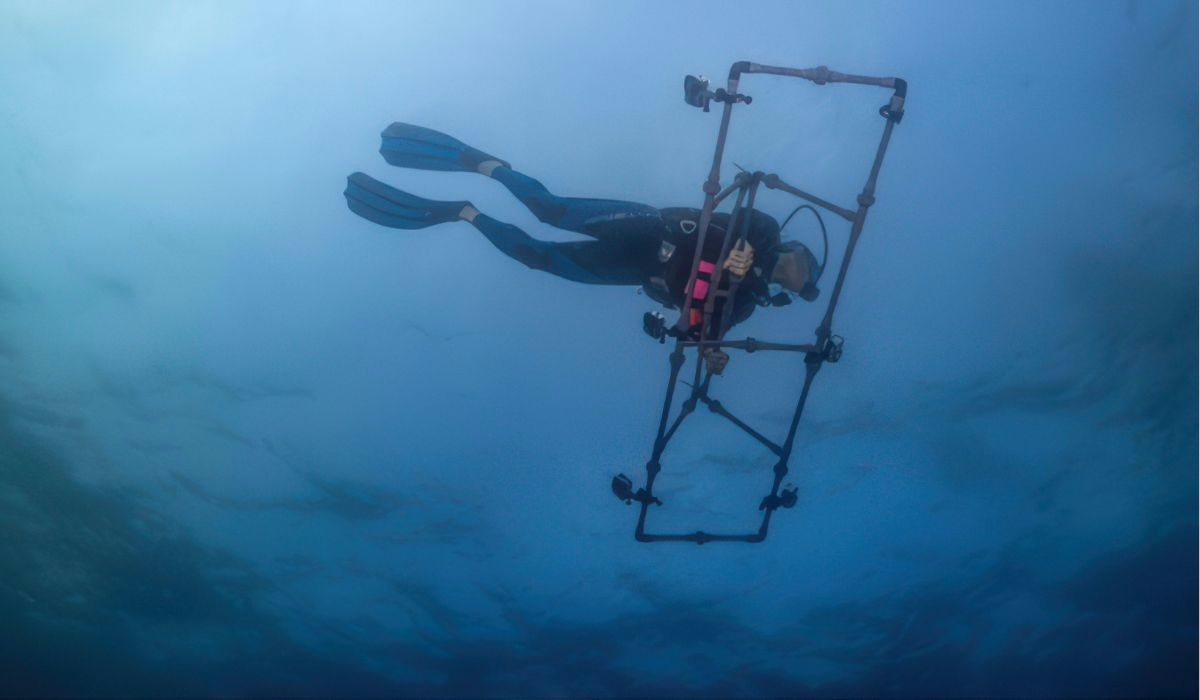
Although they may appear in the background in the shots of shimmering fish taken by diving enthusiasts, corals are at the forefront of many scientists’ minds, given their fundamental ecological role. These animals with their limestone skeletons are among the most diverse ecosystems on the planet: although they cover less than 0.1% of the total surface area of the oceans, they are home to almost a third of known marine species. They also have a major impact on the lives of people in many reef-bordered countries: according to a study by the US Oceanic and Atmospheric Administration, up to half a billion people worldwide depend on coral reefs for their food security and tourism-related income. Endangered by rising ocean temperatures and local anthropogenic pollution, which cause coral bleaching and death, corals are the subject of in-depth studies, such as those carried out by the Transnational Red Sea Center (TRSC), which aims to unlock the secrets of Red Sea species that are particularly resistant to the stresses of climate change. DeepReefMap, an artificial intelligence developed by the Laboratory of Computational Science for the Environment and Earth Observation (ECEO) at EPFL, was tested as part of this EPFL-led mission*. It is capable of reconstructing several hundred metres of coral reefs in 3D on the basis of an underwater film taken by a commercial camera in just a few minutes. It can also recognise and quantify certain coral characteristics. “This method democratises the digital reconstruction of reefs and gives a major boost to their monitoring by reducing the work, equipment, logistics and IT costs involved,” points out Samuel Gardaz, TRSC project manager. This research has now been published in Methods in Ecology and Evolution.
Classify corals according to their state of health and shape
In order to further facilitate the work of their biologist colleagues working in the field, the scientists have included semantic segmentation algorithms to classify and quantify corals according to their state of health – from healthy, i.e. very colourful, to dead and covered in algae, via the white of bleaching – and to identify the forms of coral growth that are most common in the shallow reefs of the Red Sea according to an internationally recognised hierarchy – branching, massive, hard, soft, etc. -. “The aim was really to meet the needs of scientists and conservationists working in the field with a tool that can be deployed widely and very quickly: in Djibouti, for example, there are 400 km of coastline”, stresses Jonathan Sauder, who made the development of this AI the subject of his doctoral thesis. “Our method does not require a costly IT infrastructure: on a computer equipped with a simple graphics processing unit, semantic segmentation and 3D reconstruction can be obtained in the same amount of time as the video”.